

Ajeya Cotra recently wrote about the stable marriage problem (how do you match a population of N straight men and N straight women, such that in the end, no two people would rather be with each other than their actual spouses?) and the Gale-Shapley algorithm for solving it: in each round, every man asks out their favorite woman, and every woman accepts her best offer; in every subsequent round, every unmatched man asks his next-favorite woman out, and the single women accept their best offer, while taken women are also free to monkey-branch to any new suitor she likes better than her current boo; this continues until everyone is matched, at which point everybody gets married! Yayyyy!
Cotra points out some implications1:
[T]he Gale-Shapley algorithm is always male-optimal. “Male optimal” doesn’t mean men on average get a better deal than women on average: it means all men simultaneously get the best possible wife they could have gotten in any possible stable arrangement….And at the same time, the algorithm is always female-pessimal: of all the possible valid stable marriages, every single woman gets her worst possible stable husband…
Ask for what you want
As a woke feminist lib myself, I don’t see the algorithm here as fundamentally “male”-optimal and “female”-pessimal: it is asker-optimal and askee-pessimal. The problem rewards agency and punishes passivity, to an astonishingly strong degree.
So if the Gale-Shapley algorithm is asker-optimal, why don’t women ask men out? Are women just stupid? Lazy? Cowardly? Conformist? Unagentic?2 Or is the real world less asker-optimal for women?
How is the actual marriage market different from the stable matching problem?
Life is very complicated (you heard it here first) so we could go on more or less forever in answering this question. So I will try to stick to the most salient points here. This means I will be ignoring, for instance, the fact that not everyone is straight and after the kids/marriage package; I’m also ignoring people who do want the “kids and(straight) marriage” package but who for whatever reason have very different biological clocks. Sorry! Believe me, y’all didn’t want to be in this discourse anyway.
In the stable matching problem, everyone starts the game at the same time and everyone ends the game at the same time; everyone has the same number of rounds. Everyone’s ranked partner preferences stay stable over time. Everyone is there because they want to get married; there’s a sort of “dating” period between the first and final rounds, but no one wants to date a partner that they don’t want to marry. The real marriage market is not like this.
The role of time in dating is one of the major differences between real life and the stable matching problem. In the stable matching problem, time is just kind of an inert matrix. In real life, time is an active ingredient, and time effects women and men differently.
In real life, new people enter into their dating lives on a rolling basis, and exit on a rolling basis—and the exits may not be as permanent as one hopes. People don’t date in a closed, stable cohort. There’s no agreed-upon end point where everyone stops dating. Partners have to decide, together, when they’re done playing, and one partner can later defect. This uncertainty obviously affects both men and women. But…
In real life, women get to play fewer rounds than men do. Yeah, yeah, women don’t like their men that much older. But even a small preferred age gap can really effect people’s options. When you get to play even one fewer round than your partner in the matching game, the strength of your partner’s preference for you obviously matters much more.
In real life, how much a given person prefers a given partner changes over time, and men’s preference to match with a given woman lowers more over time than women’s preference to match with a given man. Men prefer youth when matching with a woman more than women prefer youth when matching with a man. Another reason that a round spent matching with/dating someone that doesn’t end in a marriage, is more costly for a woman than a man.
BUT! EVEN MORE IMPORTANTLY! In the stable matching problem, everybody only cares about one thing, and it’s fucking disgusting marriage. This means that being asked out (or accepting) has a pretty unambiguous meaning. But:
In real life, sometimes people want to date3 partners that they don’t want to marry.
Men are more likely to want to date4 partners that they don’t want to marry than women are. Again, the differences don’t have to be huge for them to really matter in aggregate. Because of these aggregate differences, men can expect to achieve their preferences by focusing more of their effort on getting nonmarital partners than you would expect from the raw ratio of how much they want nonmarital partners to how much they want a wife; women can expect to achieve their preferences by focusing more of their effort on getting married than you would expect from the raw ratio of how much they want nonmarital partners to how much they want a husband. This really, really sucks.
The current rules of the game are that you kind of aren’t allowed to decide that you want to marry someone without dating them first—and it’s unpredictable at the outset how long . Why buy the cow if you can get the milk for free…but why buy a foundation that you haven’t tried on? It is unpredictable how much time each partner will take to come to a conclusion; it’s considered reasonable to take years to decide. It’s negotiable…but someone who wants a relatively quick decision (especially a woman who wants a relatively quick decision) is in a bad negotiating position, because the alternative options also involve an unknown period of decision-making.
THIS ADDS UP TO MEAN THAT:
In real life, when you ask someone out, or accept an offer, the thing that you are offering/accepting is ambiguous, and what looks like a reciprocal ask/acceptance match might not be as reciprocal as it looks.
A lot of this “should women ask men out” discourse is focused on rejection. People talk like fear of rejection is the main thing that women need to overcome to gain these asker-optimality benefits. “Women need to risk rejection just like men,” “Don’t worry, ladies, it’s scary to ask men out but they probably won’t reject you!” That’s true! A man probably won’t reject a woman who asks him out! THAT’S THE FUCKING PROBLEM!!!!!!!!!!!!!! Information is a measure of surprise. When a woman asks a man out and he accepts, she has very little additional information about how much he likes her compared to before she asked.
A man gets much more information from asking a woman out and being accepted, than a woman gets from asking a man out and being accepted. Steve Stewart-Williams discusses the Clark-Hatfield study and its replications (yes it replicates), which compares men’s and women’s receptivity to different sexual and romantic approaches (“wanna go on a date?”; “wanna come up to my apartment later?”; “wanna fuck later?”). Sascha Kunz and Tobias Greitemeyer performed two naturalistic replication studies in 2021; that’s recent enough to be especially applicable to today’s dating environment. Look at these tables from their study.
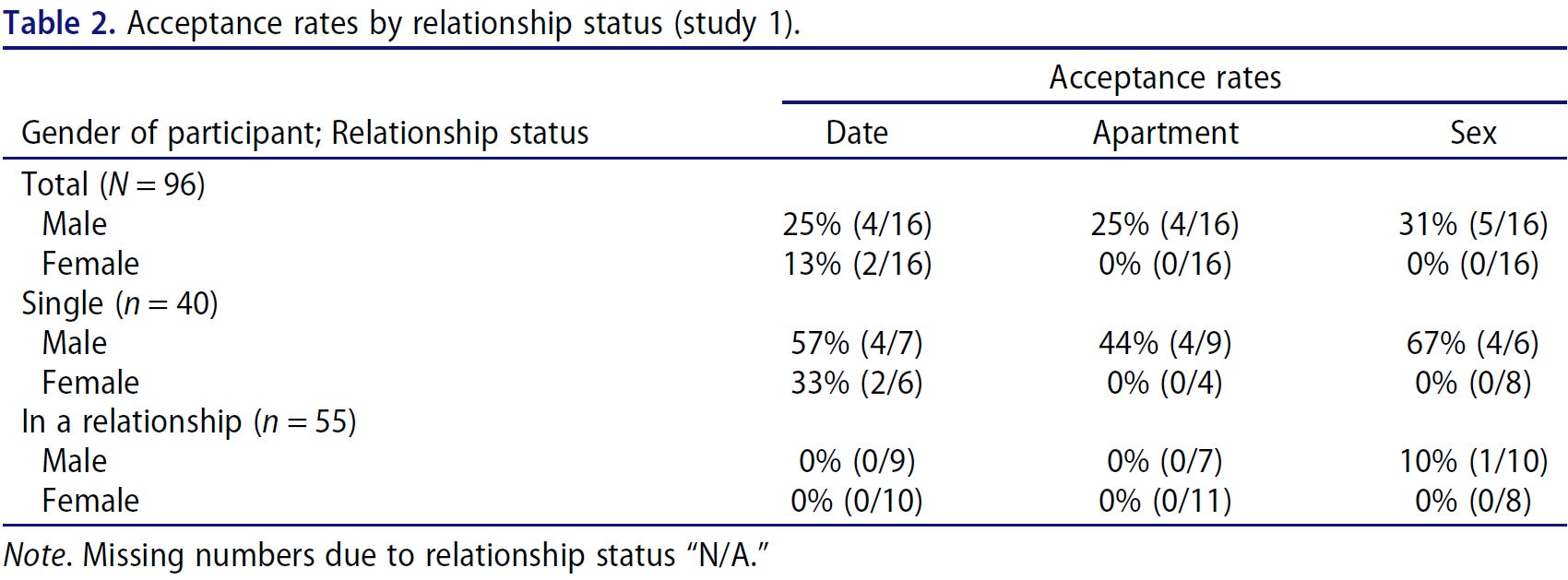

Compared to the stable matching problem, the real marriage market has two basic gender asymmetries which mean that asking men out benefits women much less than asking women out benefits men. One asymmetry is that women get much less information from asking men out than men get from asking women out. The other asymmetry is that “time spent uncertain of whether your partner prefers you enough to marry you” costs much more for women than for men.
Some Things You’ll Notice I Didn’t Say
I didn’t say that asking a man out will make him like you less. Asking a man out will make him like you more! Asking a man out will probably work for making a man who did not want to go on a date with you, want to go on a date with you. It may make him like you more than that. But that date will have a much higher opportunity cost for you than it does for him. Wait…who’s paying for dinner?
I also didn’t say that a man who doesn’t ask women out is less attractive to women—or that a man who doesn’t ask a particular woman out is less attractive to that particular woman. It’s generally true! But even when it isn’t true, when the woman doesn’t dislike (or even prefers) that kind of reticence, she should still expect that asking men out will give her less information and have higher opportunity cost.
I also also didn’t say that if a man asks you out, that means he really likes you. Obviously, men who ask a lot of women out, will be overrepresented in the group of men asking you out, compared to men who only ask women out in touching Kdrama-like confession scenes, compared to each type of guy’s incidence in the population. If only there was some way to figure out the probability that a specific man really likes you given that he’s asked you out, based on your prior probability that he really likes you, the probability that he asks a woman out given that he really likes her, and the probability that he asks a woman out given that he doesn’t really like her. We could call it girl math.
I also also also didn’t say that asking a man out will never work. Another big difference between the real world and the stable matching problem is that men and women aren’t each locked into a gender cartel strategy. You can use whatever strategy you think is best at a given time, with a given person. You can ask some men out; you can wait for other men to ask you out.
When should you expect asking men out to work?
If it’s already working for you! Maybe this goes without saying. But like. I’m writing partly to an audience of women who might have changed their life strategy in response to learning about a math problem. If you’ve changed what you do in response to abstract information once, you might do it again. This is not always a good thing.
You should expect asking a man out to be more likely to work in situations where asymmetries between the genders are muted, absent, or suppressed. If you want more nonmarital partners than the average man does, if you reasonably expect to have a much longer span of dating than most women, if you do not want a particularly masculine or high-agency partner, if sex is like pizza (“even when it’s bad it’s still pretty good!”) instead of a very fat-tailed range of valence in experiences, etc. Or if you’re in a situation where men doing stuff like “seeking nonmarital partners” and “taking a long time to decide whether to marry a partner” are suppressed or punished—in religious social groups that take chastity seriously, there’s a lot less asymmetric downside to asking a man out.
You should expect asking a man out to be more likely to work if you rarely feel surprised by men you’re dating, if you find that dating is less confusing for you than it is for most women—if you understand people (or at least the kind of people you date) well enough to kind of “eat” the ambiguity in a man accepting your offer of a date.
You should expect asking a man out to be more likely to work if you have lower transaction costs: if it’s easier for you to date multiple people at once, easier for you to break up with people, if you rarely get hung up on a man.
You should expect asking a man out to be more likely to work if there’s an obvious reason he’s not asking you out and that reason doesn’t bother you. Maybe he’s shy and doesn’t ask people out at all.
If there is a reason that you would expect him to be more likely to reject you if he doesn’t like you than the average man getting asked on a random date, then you will get more information by asking him out. Like. Say he’s your boss. Horrible example, dating your boss is not a good idea even if it’s your idea. But if it’s risky for him to accept you, he’s less likely to just go along with it if he’s not particularly into you. But don’t date your boss. But you see what I mean. Higher chance of rejection = more information.
You might as well ask a man out if you’re young and have time to spare and you really feel like it.
You should expect asking people out to work better if you fit one of the exceptions I explicitly named earlier.
Asking a man out also works if you don’t care how much he likes you. Like if you genuinely just want to have sex with him. Or if you’re hoping to rob him, blackmail him, spy on him, or otherwise use or harm him. Asking men out works really well as a way to get into their houses when they shouldn’t let people into their houses. If your situation has a lot in common with the Book of Judith, asking him out is likely to work.

What else can you do besides ask a man out?
The stable matching problem elides a lot of options for agency that exist in the real world. You can change how much men like you—we’re not going into depth on this, this topic is better covered by the whole rest of the internet. You can also do the navigation-by-moonlight thing of subtly steering the situation, yadda yadda yadda. But the most important thing you can do is GO BE PART OF A DIFFERENT MATCHING PROBLEM!!!!!! MOVE! MOVE!!!!!!!!!!!! Go visit every friend you have in every major city. Make them throw a party for you. Move to the city with the best options! Move!!!!!
The age penalty for women is a lot less serious in major cities than in smaller cities or towns, because it takes everyone longer to match up. But the dating market is rougher in like basically every other way…unless you are strange enough that smaller cities/towns don’t have anyone for you. Is this tradeoff worth it to you? THEN MOVE!!!!!!!!!!!!!!!!
What is the point of all this
Cotra’s piece is largely about asking for things you want in general. The subtitle: “Or, ask for things.” The “Ask for what you want” subheading. The last two sentences: “If you only ever pick from offers you get, you never try anything unless someone out there already knew you and liked you enough that they took the trouble of coming to you. If you ask for stuff, you get to pick from among the entire universe of potential options theoretically available to you — and who knows, it might work out.” I agree with this! In general! But I don’t think it works for women asking out men. In fact, I suspect that the reason that women have a hard time asking for things in general is specifically because asking men out works so poorly.
I basically disagree that asking men out works, but I agree that more asking-for-things-in-general is great. My feminism-inspired forays at asking men out were bad ideas, but I had figured out that I shouldn’t do that by my early 20’s. I figured that even though it didn’t work for me, and wouldn’t work for most women, maybe it was the kind of advice that would mostly be seen and followed by women that it would work for. But when I read Cyn’s great piece about asking men out, and stopping asking men out, I was like, okay, I am not literally the only woman in the world who has tried this strategy and found it wanting, maybe this is worth talking about.
I’m not even saying you shouldn’t ask men out. But if you’re asking men out because you read about the Gale-Shapley algorithm & thought asking men out was like a $20 bill on the ground—and then it turns out there are no $20 bills on the ground, or the $20 bill you picked up was covering a pile of street shit & that’s why no one else took it, or whatever—I don’t want you to think, “Jesus, I’m using a better braver more agentic more optimal dating strategy than most women are and things are still going poorly for me….do I just suck?” Asking men out is definitely the narratively high-agency choice. You can just do things. But if doing the thing doesn’t work, then do something else.
And also introduces a way to model people prefering to be single, without messing up the underlying math.
Cotra does not imply any of these things. But other people are.
Euphemistically.
Euphemistically.
I guess "Contra Cotra" was too on the nose?
> Men are more likely to want to date partners that they don’t want to marry than women are.
So what information does the woman gain when a man asks her out? This argument rests on the assumption that a man asking her out is more likely to marry her, when the article itself states that the act of being asked out is not evidence of wanting marriage.